Loading experience
Trial Advocacy Training, Under Real Pressure.
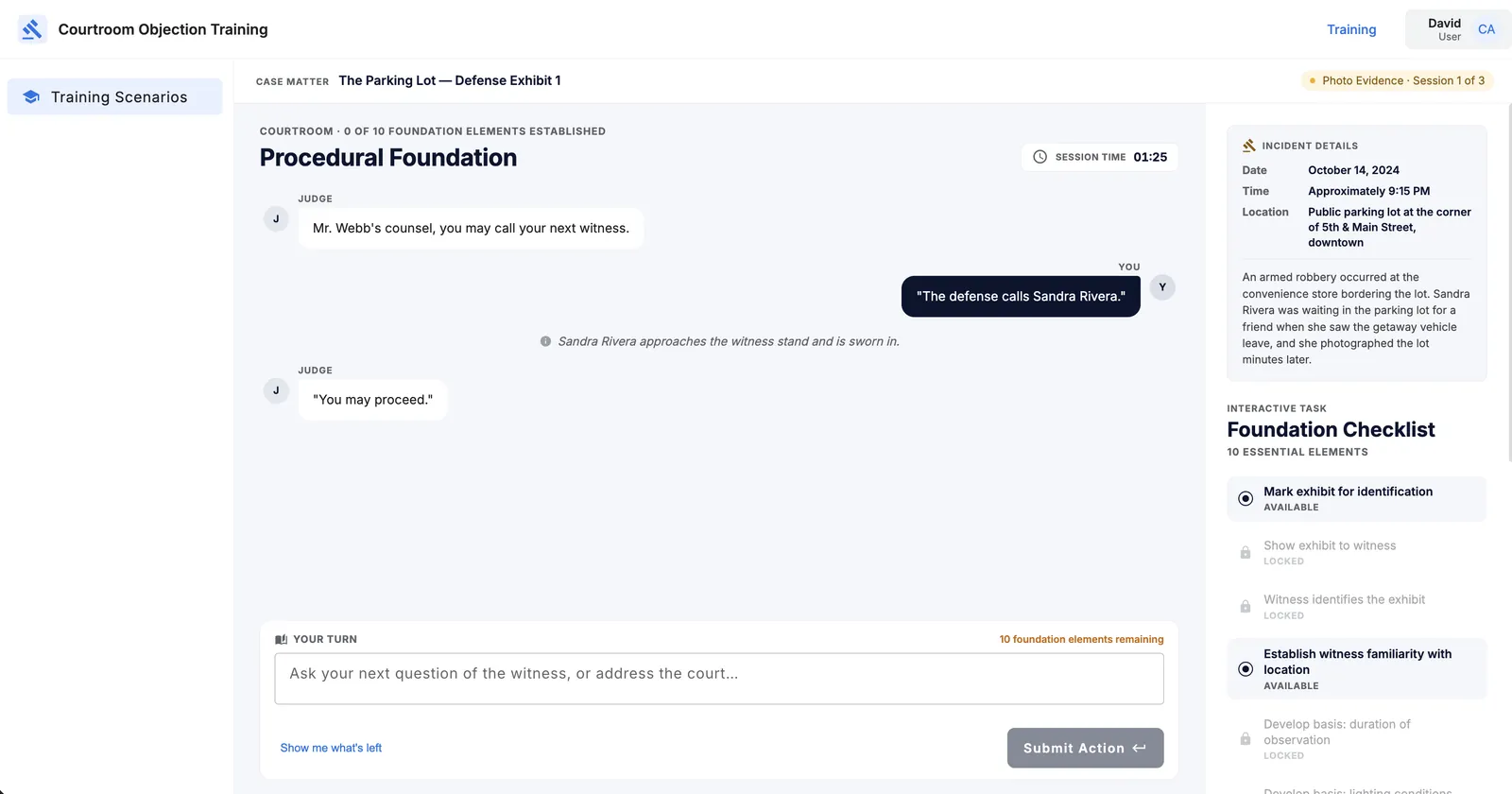
Most evidence training stops at multiple choice. Trial Trainer puts students in a simulated courtroom with judge, witness and opposing counsel, laying foundations and fielding objections in real time.
Attorneys have under three seconds to object in a real trial. Trial Trainer is built for that clock.
Teaching law students to argue under pressure.
An AI-simulated courtroom where law students lay evidentiary foundations and handle objections in real time, because knowing the law and performing it are two different things.
To object in a real trial, with no time to reflect
Validation before content reaches a student
Baseline AI-accuracy target on evaluations
At a glance
- Domain
- Legal education · trial advocacy & the rules of evidence
- Next2AI role
- Technology and research & development partner
- Grounded in
- Evidentiary Foundations (13th Ed.) by Edward J. Imwinkelried
- Status
- In development, text simulation now and real-time voice next
The challenge.
Legal education assumes that learning the rules of evidence means knowing how to apply them. That breaks the moment a student stands up in court. An attorney has less than three seconds to raise an objection or answer one. A student who can recite the requirements still freezes when it happens for real.
- Rules are learned, never performed
- Under 3 seconds to object
- Courtroom pressure can’t be staged in class
- Students freeze when counsel objects
Why existing tools fall short.
Gamified tools
Trade professional rigor for engagement mechanics that don’t reflect the seriousness of courtroom practice.
Static quizzes
Test recall, but never place a student under any real pressure.
Neither replicates the actual experience of trial: the back-and-forth with a witness, the sudden objection, the need to think and speak at once, with no do-overs.
The solution.
Instead of answering questions in isolation, students run an examination step by step, laying a witness’s foundation, offering evidence, and handling objections as they come.
Judge
Rules on objections in real time
Witness
Testifies while the student lays the foundation
Opposing counsel
Objects, sometimes rightly, sometimes not
The student must recognize the gap and repair their foundation.
The student must argue why the objection should be overruled.
Opposing counsel doesn’t always object correctly, just like real trials. Immediate feedback names the exact foundational step missed or handled well, so students learn why each objection stood or fell.
Inside the first scenario.
A junior defense associate must admit a photograph, an alibi exhibit, into evidence through the testimony of a neighborhood witness. It tests the full arc of laying a photographic foundation under realistic conditions, with opposing counsel challenging every step.
Built for accuracy.
Training future lawyers makes accuracy non-negotiable. Every scenario is grounded in Evidentiary Foundations (13th Ed.) and passes five tiers of validation before a student sees it:
- 01
Automated citation checks
Every claim checked against citations in the source text.
- 02
Expert panel review
Three trial lawyers blind-review AI evaluations, watching gray-area objections.
- 03
Dual-model verification
Two independent AI reads of the same objection; disagreements flagged for humans.
- 04
Confidence scoring
Any low-confidence response is routed to a human reviewer.
- 05
Red-team testing
Trial lawyers probe the system with edge cases before students see it.
Design targets, since the platform hasn’t launched yet: a baseline AI accuracy of 85%+ on evaluation scenarios, and measurable improvement in a student’s objection accuracy by their third session.
Status & what’s next.
Trial Trainer is in development, with its core AI evidence engine and a text-based simulation as the present focus.
- Now: text-based simulation on the core AI evidence engine
- Next: real-time voice, speaking objections aloud under the clock
- Later: further phases, defined by what the first stages teach